FRESH BITE
Making Healthy Eating Accessible for Students
A student-focused meal kit service using rescued produce and campus kiosks to make healthy eating affordable and accessible.
Timeline
16 Weeks|Spring 2025
Role
Lead Service Designer
Tools
Figma
FigJam
Google Suite
Advisor
Danny Stillion
Platform
Mobile
Team
Service Designer
Backend Dashboard
Service Designer
Customer App
Industrial Engineer
Hardware Touchpoints
Service Designer
Driver's App


OVERVIEW
12 renters. One recurring theme: the search feels rigged.
Existing meal kit services charge $60-80 per week with mandatory subscriptions, making them financially out of reach for students who default to expensive takeout.
FreshBite is a campus-based meal kit service made affordable through rescued produce and smart kiosks.

MY ROLE
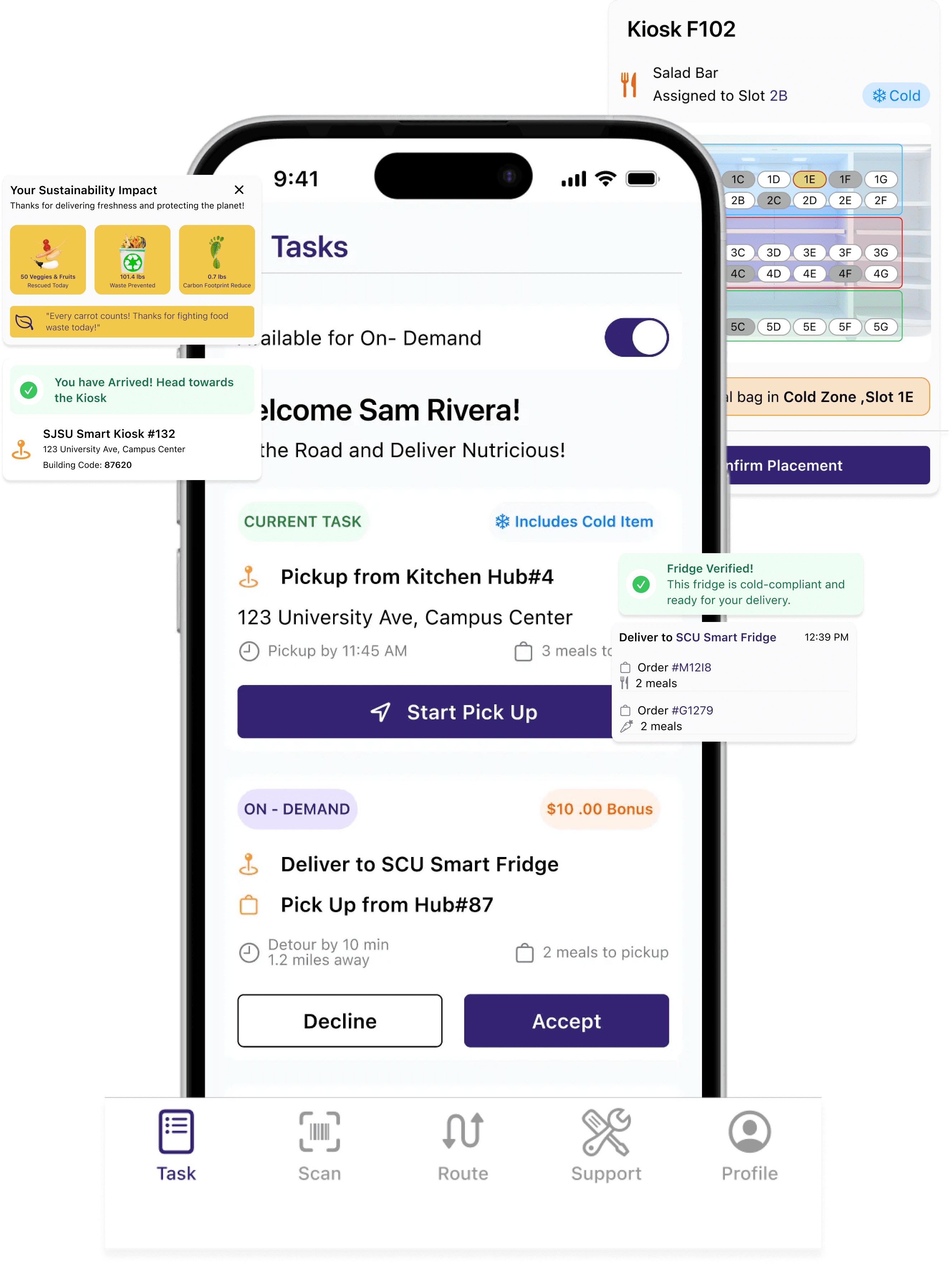
I led the research strategy that identified real student barriers, then designed the delivery driver app, the invisible infrastructure that made the campus kiosk model operationally viable.
RESEARCH
Existing meal kit services fail students because of inflexibility, not affordability alone.
We conducted surveys (50+ students), focus groups with meal kit subscribers, and interviews with dining commons staff at SJSU.

Key Insights
Control > Cost
Auto-renewals were dealbreakers. Weekly $60 charges don't work when budgets fluctuate. Students wanted to order 1 meal or 10 without commitment.
Predictable Effort
Recipe times were wildly inaccurate. If it said "20 minutes" but took 45, they'd order pizza instead.
Automatic Sustainability
Students cared about waste but didn't know what to do with confusing packaging. Make sustainability the default, not a conscious choice.
THE UNLOCK
An interview with the dining commons at SJSU revealed our entire model.
During our SJSU dining staff interview, they mentioned local farms had tons of perfectly good produce they couldn't sell because it looked "ugly", crooked carrots, small tomatoes, cosmetically imperfect but nutritionally identical.
Rescued produce = 40% cost reduction + food waste prevention

THE SERVICE MODEL
Campus kiosks solved the delivery cost problem while giving students control.
Door-to-door requires individual routes and precise timing, impossible for students constantly in class.
Why kiosks worked?
One route serves 50 students instead of 5
60% lower delivery costs
Students pick up on their schedule


How Might We
Make complex logistics feel effortless while maintaining food safety.
DESIGN PROCESS
Iteration 1
My first version - Detailed task lists and camera-based verification overwhelmed everyone.
Key feedback
"I don't want to spend my time trying to get a clear photo. Just let me scan and go."
Before
Camera Verification: The camera system was slow and error-prone, and photos failed in low-light or at incorrect angles.

After
RFID Verification: Replace cameras with RFID auto-detection. Sensors confirm placement automatically.

Iteration 2
Building confidence through visual clarity.
Before
Uniform Grid Layout: Drivers scanned a generic number grid to find their slots, causing slowdowns and increasing the risk of placing cold items in the wrong temperature zone.

After
Spatial Guidance: Visual temperature maps (blue=cold, orange=warm) guide drivers to the correct section, mirroring the kiosk layout and minimizing cognitive load while ensuring food safety compliance.

Before
Static Task Lists: Drivers worked from generic task lists that treated all items equally. Without handling alerts or completion feedback, accuracy relied solely on the driver's memory, increasing the risk of cold-chain errors.

After
Guided Compliance: Temperature Tags alert drivers to handle sensitive items correctly, while Status Indicators enable drivers to self-check their workflow, ensuring food safety protocols are consistently met.
Iteration 3
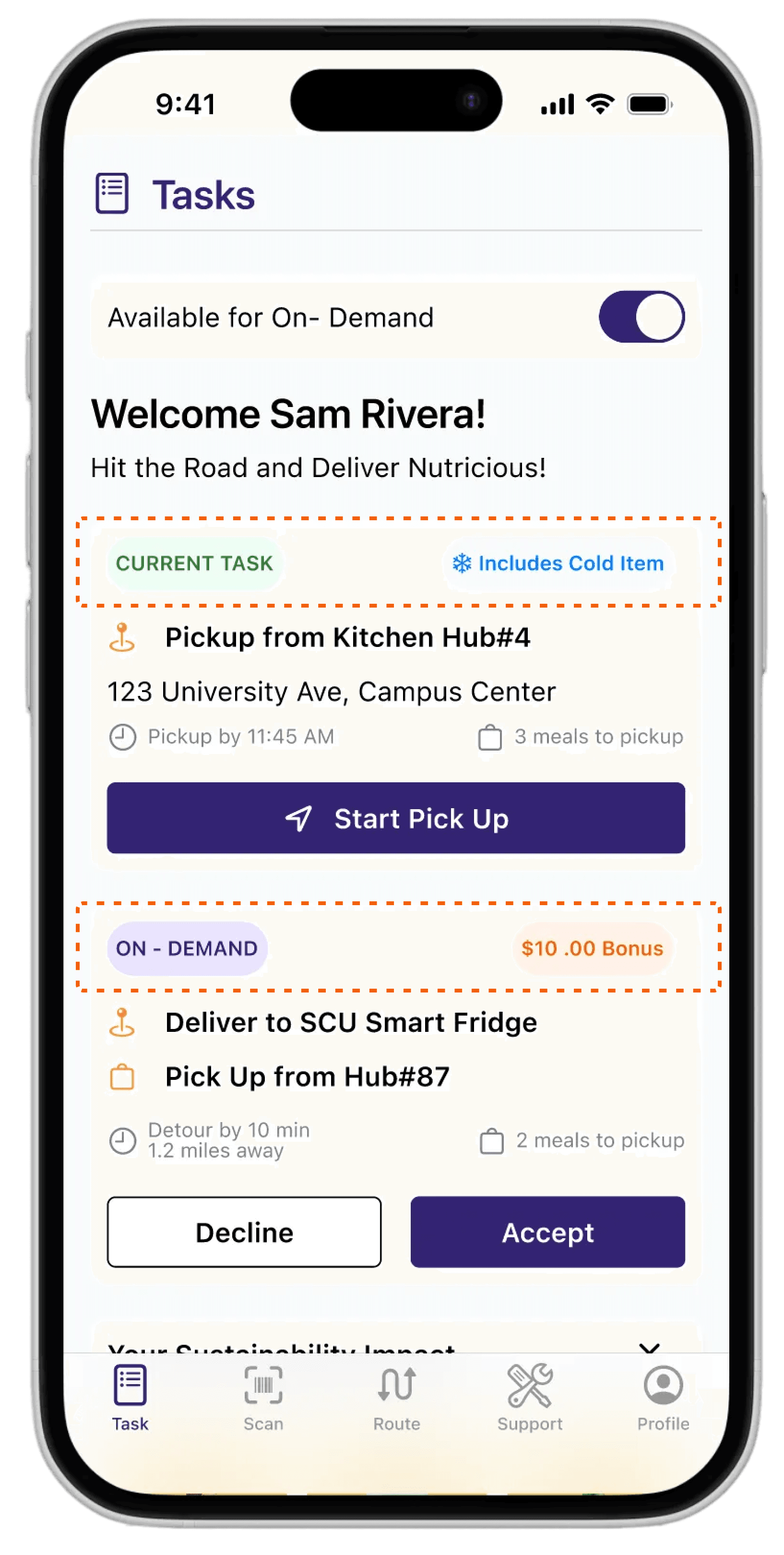
Drivers wanted autonomy, not fixed schedules.
I designed batched deliveries, fixed routes at set times. Testing revealed this didn't match how drivers wanted to work.
Drivers wanted the ability to opt into on-demand tasks between routes for additional income, not be locked into predetermined schedules.
The shift to on-demand
Geofenced requests
(only drivers within 10 minutes notified)
Transparent incentives
Before
Rigid Schedules: Drivers were locked into pre-assigned, batched routes with zero flexibility.

After
On-Demand Autonomy: A new toggle lets drivers opt-in to nearby, high-value tasks to earn extra income between routes.

SOLUTIONS
Three critical moments that make or break delivery.
The Overview consolidates what previously required 30 minutes checking multiple reports. Information is organized by task priority: recognition and alerts at the top, performance trends and queue in the middle, model status at the bottom.
1. Pickup: Visual Clarity
Checklist with meal icons. Real-time scan confirmation. Green "Scan Complete" eliminates missed items.
2. Navigation: Context-Aware Routing
Exact kiosk locations, building codes. Manual "I've Arrived" when GPS is unreliable.
3. Placement: Temperature Safety
Color-coded compartments guide temperature matching. RFID sensors auto-confirm placement, eliminating manual photos. If a meal is misaligned, the app instantly prompts the driver to adjust it for a successful scan.
REFLECTION
Service design is about making invisible complexity feel effortless.
Students see affordable meals and an app. They don't see the rescued produce supply chain, driver routing algorithms, or temperature sensors.
The driver app taught me that design isn't about adding features, it's about removing friction.
The work that matters most is often the work users never see.
